
Browse our services
Explore how Shearwater Law can help you

Find a maritime expert
Meet our team, find and expert and connect

Talk to our experts
Get in touch, we're here to help

Courts are becoming increasingly less sympathetic towards sea carriers in global cargo disputes, according to David Richards, director at global maritime and commodities law firm Shearwater Law and former deputy global head of P&I claims at NorthStandard.
This more recent shift in judicial attitude reflects a growing trend of stricter legal scrutiny as courts within the UK judicial system rule on cargo claim disputes, with several cases in recent years highlighting how carriers now have greater liability for cargo damage and loss.
In 2019, the UK Supreme Court changed the traditional understanding that a carrier does not have to prove it had taken reasonable care of cargo. For example, the Supreme Court decided in 2021 in The CMA CGM Libra that a vessel could be unseaworthy where there were serious defects in pre-voyage planning, including cargo stowage planning.
Some limited respite was offered in The Giant Ace in 2024 when the Supreme Court allowed a carrier to rely on the time bar defence under the Hague and Hague-Visby Rules in a case of misdelivery occurring after the cargo had been discharged from the ship.
The lower courts have also handed down decisions that have ruled against carriers. In 2019, in The Sur, the High Court applied the long criticised ‘geographical deviation’ rule to preclude a carrier from relying on contractual defences, while in 2020, the Court concluded in The Santa Isabella that the carrier had failed to care for cargo due to inadequate ventilation.
In January 2026, the English Admiralty Court ruled in favour of the cargo owners in The Happy Aras by finding that the vessel, which had grounded off the coast of Turkey in March 2023, was unseaworthy after the Master made multiple serious errors.
“There are thousands of cargo claims each year and only a handful of cargo disputes come before the courts. We’ve seen more rulings on cargo claims coming from the UK Supreme Court in recent years, which has not traditionally been the case. There is perhaps an emerging trend of courts being less sympathetic to carriers in these types of cases.
“There are traditionally a number of defences that carriers have to claims that are still being used. However, some of these defences are pretty much redundant in the modern era, although others remain robust. Understanding on the risks, challenges and relevancy of cargo claims today is vital for anyone working within P&I claims and maritime law,” said Richards.
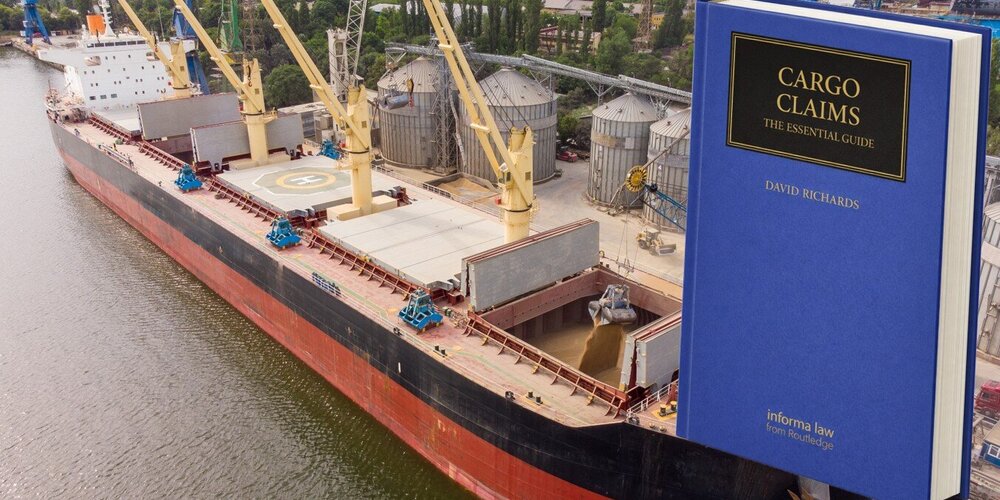
This evolving legal landscape is addressed in depth in Richards’ new book, Cargo Claims: The Essential Guide. The book, which was released on 25 March, is published by Informa Law, an imprint of Routledge, as part of its Maritime and Transport Law Library section.
The launch of Cargo Claims: The Essential Guide is designed to fill a long-standing gap in shipping law textbooks as there has not been a title focused on cargo claims in nearly two decades. According to Richards, the new book is designed to give those working within marine insurance, law firms and shipping companies a modern overview of the current law and the trends that are impacting cargo claims.
“Major container lines will face about 20,000 cargo claims every year while a large P&I club might get up to 10,000. These types of claims are the bread and butter of what many in this industry face every single day and there is no up-to-date single text on the market that focuses on modern cargo claim challenges and helping shipping professionals understand the legal issues surrounding them.
“With the UK Supreme Court taking on more cargo claim cases in recent years, it is clear the judicial system is taking these types of cases more seriously, particularly as the types of cargoes involved are becoming more varied and complex, and exposing carriers to new types of risks. This new book is designed to look at the current trends in cargo claims through the lens of those who have legal and practical experience in defending these types of cases and provide a modern perspective to complement other literature that specialises in Bills of Lading and charterparty disputes,” Richards noted.
Written for practitioners and those working on cargo claims day-to-day, Cargo Claims: The Essential Guide is an invaluable resource for ship operators, shipping law firms, barristers’ chambers, cargo recovery agencies and P&I insurers.
Cargo Claims: The Essential Guide is now available and can be purchased here: https://www.routledge.com/Cargo-Claims-The-Essential-Guide/Richards/p/book/9781041088172
Explore how Shearwater Law can help you
Meet our team, find and expert and connect
Get in touch, we're here to help